

Note from the Editor:
It is with great honor and privilege that White Rabbit Poetry Society features Master Poet and Writer Mark Crutchfield as this week’s Monday Featured Poet. Mark is an accomplished writer of many styles. He is amazingly proficient in prose, poetry, lyrics and storytelling of all kinds. Mark was kind enough to take time out of his busy schedule to write a piece for us about his process. Please visit Mark Crutchfield, subscribe and read his work.
Original Post

Pulse Before Beat
There’s a point where something shifts
and you don’t know what to call it.
Not because it’s dramatic, and not because it declares itself.
Just because something small didn’t cancel out.
I didn’t come to Substack to write poetry.
I came to carry on writing, but in a better place.
That was it.
I didn’t really separate prose from poetry.
I didn’t think there was a line dividing them.
I hadn’t studied English seriously at school.
If I’m honest, I hadn’t read much poetry at all until about six months ago.
Which still surprises people.
It surprises me too when I think about it.
But I had spent years writing something else.
Techno.
Mostly in the 90s and early 2000s.
Long nights shaping tracks that weren’t about melody so much as tension.
About rhythm.
Drums and percussion carrying the melody, and a bassline, if you were lucky, to move the room.
And something else that mattered more.
Restraint.
Compression teaches you something.
You learn that adding isn’t the trick.
Removing is.
Take out the kick drum and the whole room changes.
Pull the snare and the body leans forward without knowing why.
Strip a track back to almost nothing and suddenly every remaining sound carries more weight than it should.
You don’t escalate.
You narrow.
You let pressure build by reducing what can happen next.
I didn’t realize at the time that I was learning how space behaves.
How silence holds energy.
And, how a missing beat can say more than a layered one.
So, when I started writing here, I wasn’t trying to be lyrical.
I was trying to feel where the pressure was.
I noticed that if I removed a word, the sentence didn’t weaken.
It tightened.
If I shortened a line,
the air shifted.
If I let the environment carry something first, the emotion didn’t need explaining so much anymore. That’s when I began to sense that what I was writing wasn’t quite prose.
But I still didn’t call it poetry.
I just kept adjusting the dials.
I didn’t have a name for that yet either.
I only had the feeling that something felt more like me this way.
And then I wrote this:
The Sun Said Hop
November 8, 2025
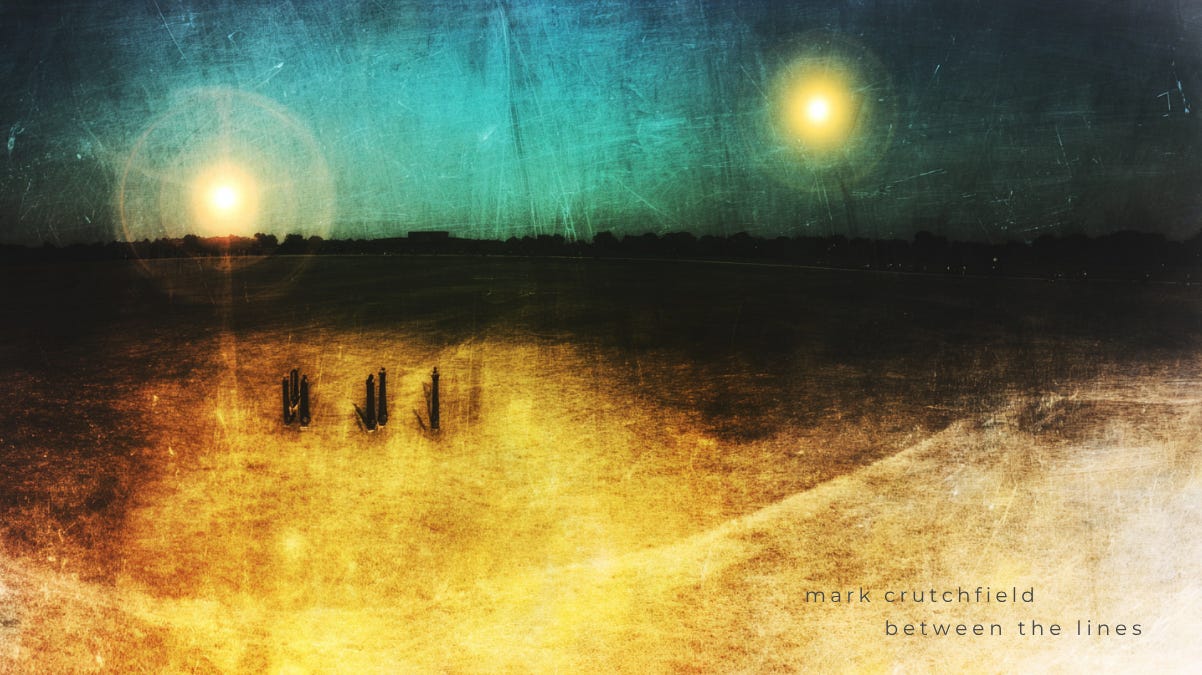
The sun said hop,
This is one of the smallest pieces I had written at that stage.
And one of the first where I realized I wasn’t just describing a scene.
I was shifting weight.
The sun said hop,
the moon slipped by.
It would be easy to read that as anthropomorphism.
A decorative move, and maybe a playful one too.
But that wasn’t what I felt I was reaching for.
I wasn’t really trying to make the sun human.
I was trying to let the sun carry motion — before any human did.
As the poem moves—
The Sun slowed down.
People wept.
The cause-and-effect blurs.
Did the sun slow because of us?
Did we weep because it did?
I prefer writing that leaves meaning with the reader.
Once I press publish, the words aren’t mine anymore.
What interested me here was the transfer.
The moment when the environment begins to hold emotion, so the human body doesn’t have to introduce it first.
Later, I began calling this Affective Animacy.
Affective — because it’s about felt emotion, not description.
Animacy — because something in the world begins to behave as if it’s alive with that feeling.
Not because I invented something.
Writers have allowed the world to breathe for centuries.
I just wanted to understand why it works when it works.
Affective Animacy, for me, isn’t giving objects personalities.
It’s allowing atmosphere to carry feeling.
It’s letting the air lean heavy before anyone explains why.
By the end—
in the silence,
in the quiet,
inside us.
The external and internal collapse into the same field.
The quiet is no longer out there.
That was the shift.
Not the image.
The relocation.
Salt Before Language
Feb 2
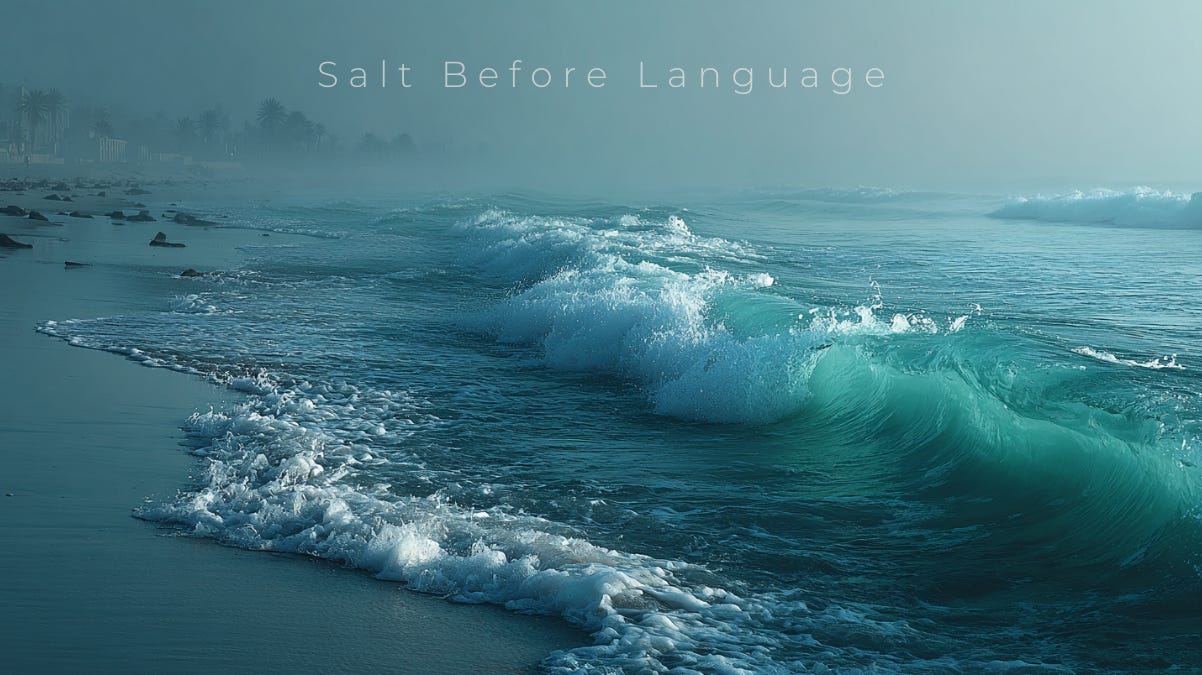
She came to see the sea,
This piece came later.
And by then, I was starting to understand that what I was exploring wasn’t only about atmosphere carrying emotion.
It was about proximity.
She came to see the sea,
but the sea saw she.
There’s playfulness in that line — sea / see — but underneath it is something else.
A form of reversal.
The subject isn’t in control of the gaze anymore, and as you may have noticed, if you’ve read anything else of mine, I often like to play with agency and who holds it.
Here, the sea isn’t just animated.
It’s responsive.
And that’s different.
Where Affective Animacy lets the world hold feeling, this poem edges into what I began calling Affective Intimacy.
If Animacy moves emotion into the world, Intimacy lets the world answer.
Not with dialogue or personality.
But with mirroring.
Sea said: I keep what you won’t say.
See said: Your silence tastes this way.
This isn’t anthropomorphism either.
The sea doesn’t become a character. It becomes a surface that returns what she cannot release.
Each wave brings something back.
Each wave returned
what she tried to release.
That return is the key.
Affective Intimacy, for me, is the moment when language allows the world to meet the body halfway.
When the external doesn’t just carry emotion — it reflects it.
By the end—
her body knew before she did —
The cognition comes last.
The body registers first.
And the sea is no longer scenery.
It’s relational.
That’s the difference.
After posting three pieces separately, I left them alone.
A week later, I placed them back-to-back.
No headings.
No explanation.
Just the same lines, in sequence.
far enough, not noticed.
Jan 20
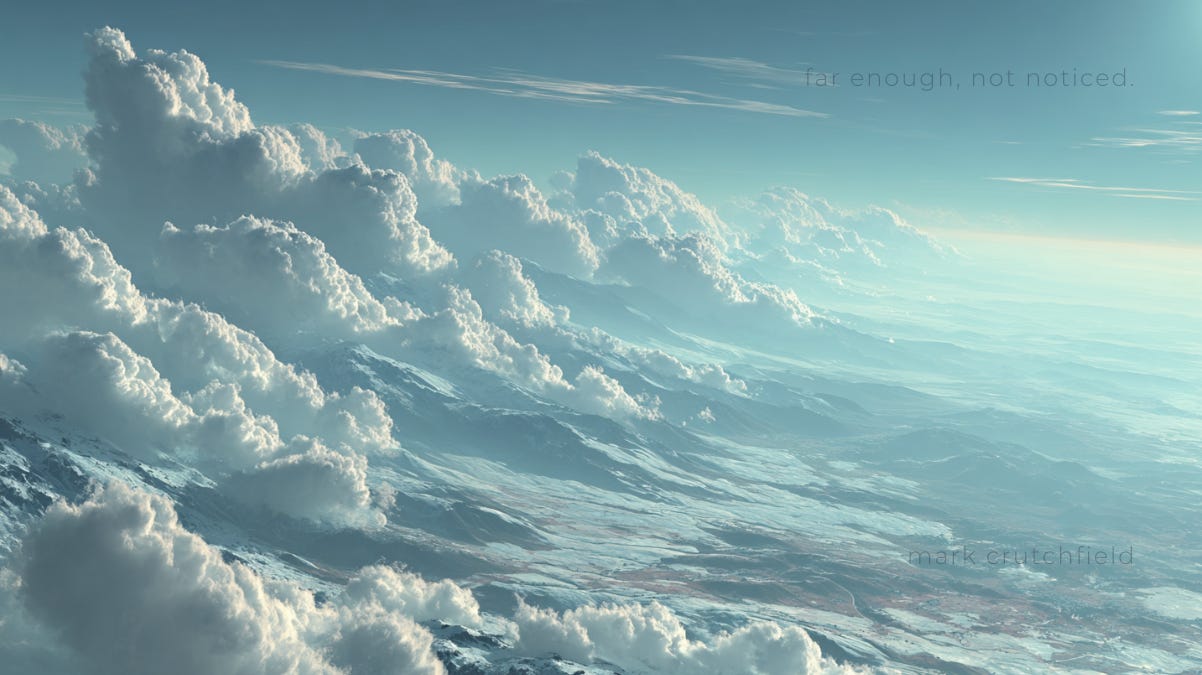
The moon feels warm tonight,
The first began with warmth —
The moon feels warm tonight
When I wrote that first section, I wasn’t thinking about a trilogy.
I was exploring where this emotional, environmental technique could go.
What happens when the world doesn’t just carry feeling, but it also participates in it?
The second piece pushed that further.
The third felt necessary.
Not really planned out or architected.
Just… and experiment.
Only after the second did I start to wonder whether they might sit together as one continuous movement.
I didn’t test that until a few days after I’d published the third piece.
Individually, each piece holds its own atmosphere, and I wanted to put them all out there separately first.
Placed together, something else happens.
The warmth of the opening shifts.
What feels comforting on its own becomes exposure when followed by fire.
And fire, when held long enough, gives way to refusal.
By the time we arrive at—
the sky didn’t look back
—the field has narrowed.
Held separately, they feel like atmospheres.
Held together, they begin to form a progression.
Trust.
Recognition.
Withdrawal.
The arc wasn’t engineered.
It emerged from proximity.
That was the small experiment I was trying.
Not whether three poems could fit together.
But whether sequence changes pressure.
And it seems like it does.
I don’t know if the trio is stronger than the parts.
But I do know this:
When you hold things close enough, they change each other.
And sometimes
that’s enough.
I still don’t think of myself as someone who “became” a poet.
I just kept following what felt different and right at the same time.
Following where the air shifted.
Where the world seemed to answer.
Where it refused to.
Somewhere in that noticing,
poetry happened.
Or maybe it was always there
and I just removed enough noise to hear it.
Note From Mark Crutchfield
I owe this piece to Dorie Snow/雪多丽 .
Connecting through Between Two Words, our shared 1960s correspondence between London and Hong Kong, in January this year, she invited me into her poetry club. That invitation mattered more than she probably realizes. Dorie writes from somewhere deeply felt. There’s no distance between her and the page. If you haven’t spent time with her work, I’d gently recommend you do.
Thank you, Dorie — for the invitation and the trust.
Note From the Editors:
Thank you so much Mark Crutchfield for this wonderful look into your creation process. I know it will be illuminating for many to take time and have a discourse with their creativity, finding new ways to communicate their art in depth. Please take a moment to visit Mark Crutchfield subscribe and read his work! Thank you so much for being here!
We are so grateful that you are here. Please leave a message if you are inspired. We would love to see what you write. The White Rabbit Poetry Society is a place to find some inspiration and even some friends. Don’t be shy—add links to your poetry!

Thank you so much @Dorie Snow/雪多丽 for a chance to join your wonderful poetry club! 🤗 💛 🤗
Beautiful and evocative Thank you for sharing your gift peace and love Claire